-
Virgin Portraits
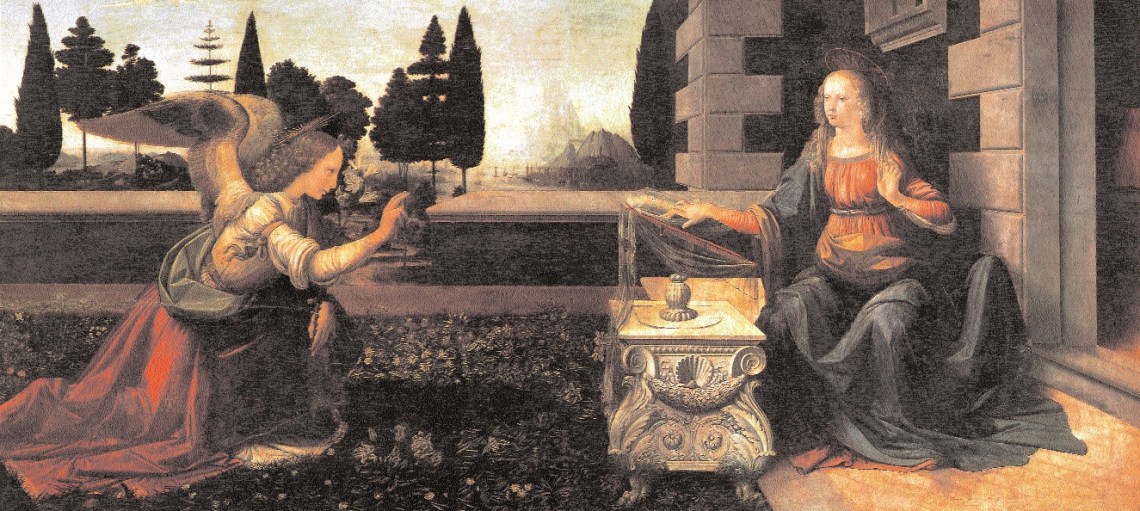
During the Renaissance, Italian painters would traditionally depict the wives of their patrons as Madonnas, often rendering them more beautiful than they actually were. Over centuries in religious paintings, the Madonna has been presented as the clement and protective mother of God. However, with the passing of time, Mary gradually lost some of her spiritual characteristics and became more mortal and accessible to human sentiments.
-
Apocalypse (English Version) – Camille Flammarion
The final book of the Bible, known both as The Book of Revelation and The Apocalypse of John, is a prophesy of the events that will occur at the end of time. This book pools the most famous pieces of art inspired by this theme, such as the Apocalypse drapery from Angers Cathedral, the carved tympanum of the Autun Cathedral, and the fresco in Albi Cathedral.
-
Christ in Art – Temporis Collection
This richly illustrated book explores the various ways that Christ is rendered in art, from Cimabue’s Nativity scenes and Fra Angelico’s paintings of the Crucifixion to the provocative portraits of Salvador Dalí and Andres Serrano. Author Ernest Renan guides the reader through the most iconic representations of Christ in art.
-
Epiphany – Three Kings’ Day Celebration
The text below is the excerpt from the book Christ in Art, written by Ernest Renan, published by Parkstone International. Jesus was born in Nazareth, a small town in Galilee, which before him was unknown. All his life he was designated by the name of “Nazarene,” and it is only by an awkward detour that the legend succeeds in fixing his birth at Bethlehem. We shall further on see the motive of this supposition and how it was the necessary consequence of the Messianic character attributed to Jesus. The precise date of his birth is unknown. It occurred under the reign of Augustus, towards the year 750 of Rome, probably sometime in the…
-
The Virgin in Art
“To Our Lady of Guadalupe Madonna of the Old and the New World with gratitude.”
-
Beauty and the Bestiary
The Medieval Bestiary was very much the Wikipedia of its day – though without the scores of undergraduates dredging its pages in search of tenuous references for their assignments the night prior to a deadline. Still, with each, the primary focus is, or was, to educate and enlighten, albeit, as far as the Medieval Bestiary is concerned, with a distinctly Christian filter overlaid. As the Horatian quote reads, “The aim of the poet is to inform or delight, or to combine together, in what he says, both pleasure and applicability to life.” Certainly, these words had a profound impact on the artists, writers and clergy of the middle ages, and…
-
A Searching Truth
Question for the day: What brings us to make particular choices? Choices which range from our music preferences to major life decisions? Religion is one such important life choice. Christianity, Islam, Judaism, Hinduism, Buddhism… the Big 5 (in terms of the most well-known religions). Today I shall be looking at Buddhism. What is the draw? Why is it becoming more and more popular in the Western world?
-
Les Belles Heures du Duc de Berry
Parisians and their visitors are in for a treat: for the last time they will get to see the beautiful, individual leaves of the Belles Heures of Jean de France, Duc de Berry, before a valuable piece of their cultural heritage is whisked off once more to foreign climes. The Belles Heures is one of the most beautiful examples of an illustrated ‘book of hours’, a ‘devotional’ book for our devout, God-fearing medieval ancestors who felt like once a week just wasn’t devoting enough time to God, so they ordered manuals with instructions on how to pray better and more regularly at home. In today’s increasingly secular society, many of…

This is an interactive art blog in multi languages, you will find new articles on artists, art history, exhibitions, etc. Contributions welcome.




You must be logged in to post a comment.